

A new community makerspace opens Friday in Dupont
What happens when mutual aid organizers build a creative hub?

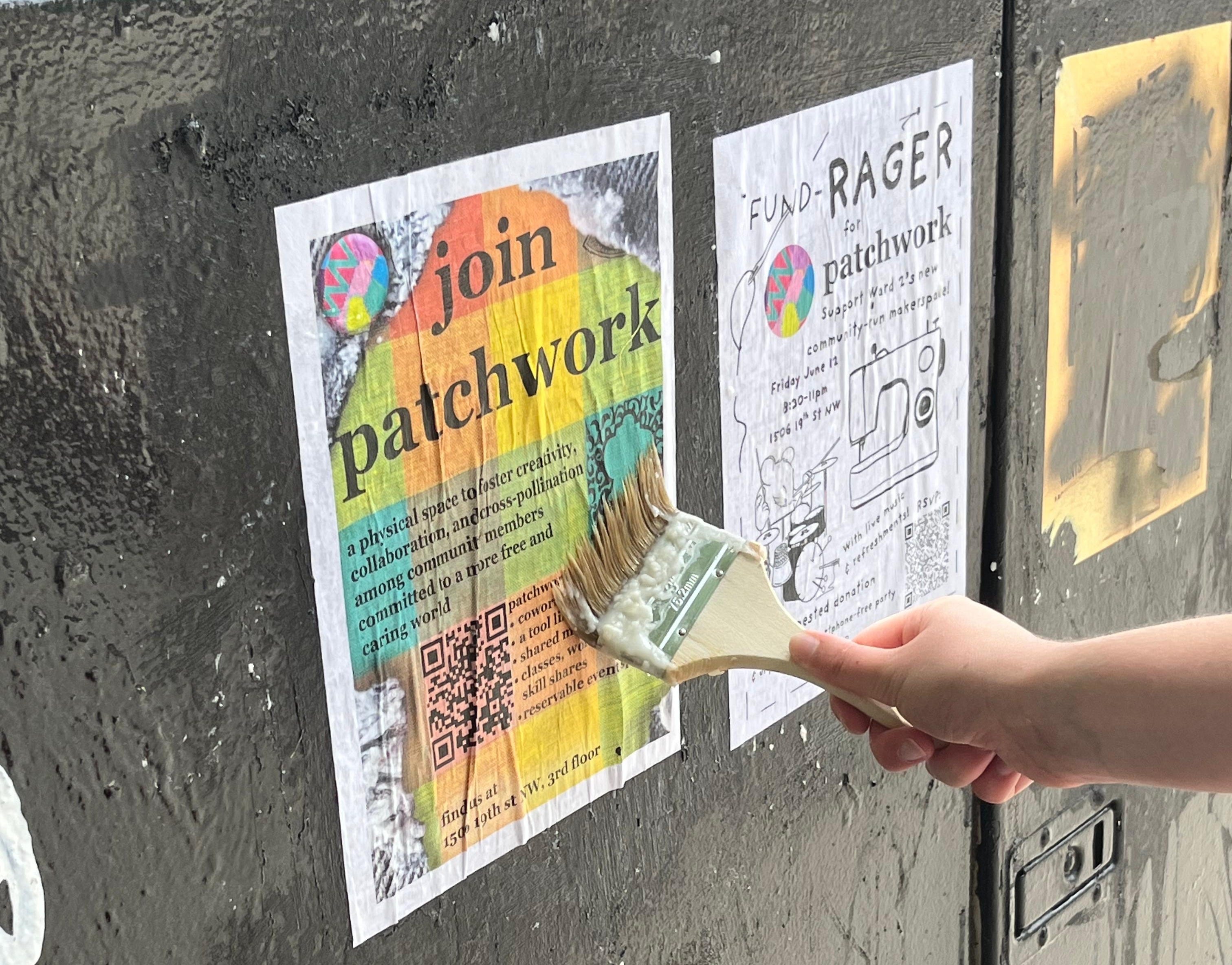
There’s a new makerspace on the verge of hatching in Dupont. Called Patchwork, the group is run by Ward 2 Mutual Aid organizers, community members, and former non-profit leaders and GWU makerspace staff. According to their website the space is “of, by, and for the working-class community.”
The group’s goal is to purchase and own a venue in Ward 2 to be a creative space for hosting workshops, a tool library, a practice and performance venue and an incubator for creative discoveries for orgs and individuals “committed to a more free and caring world.”
In the meantime, they’ve secured a temporary location in partnership with dumb.co. On June 12th they will host a fundraiser, or fund-RAGER, with live music. Inquiring minds want to know what makes Patchwork different from similar membership style art spaces. Let’s find out.
warp: Creative hubs, shared studios, and makerspaces have opened, closed, and still exist across the city. What makes Patchwork unique?
Patchwork: Patchwork is special because it is of DC’s vibrant DIY arts scene and its historic organizing tradition. One of our organizers spent the duration of her undergraduate studies running GW’s makerspace and researching The New Thing Art and Architecture Center—one of DC’s first makerspaces, a 1960s era community art space and school—and becoming good friends with its founder Topper Carew (we have his blessing to open :)). Another organizer has spent 7+ years running Girls Rock! DC, a music and leadership program for young people. Many of our organizers and founding members have worked with Ward 2 Mutual Aid, a community organization that offers direct-aid to those experiencing poverty, homelessness, and state-imposed violence. Our love for and involvement in this city’s existing and previous creative and organizing hubs make us special. We are not trying to reinvent the wheel, but there are few like-spaces in Ward 2. Patchwork is a space where people can hang out, make stuff, and organize affordably in Ward 2, hopefully, due to our membership structure, for a long while.
warp: Patchwork is described as being “community makerspace that fosters local mutual aid and the solidarity economy.” Having foundational roots in mutual aid will shape the implementation and function of patchwork, how do you see those roots coming to fruition?
Patchwork: Making is mutual aid. At Patchwork, we hope to grow our ability to take care of each other by learning how to do and make more stuff for ourselves and our community, without having to rely as much on the capitalist state. For us, this means more skill-shares, more sharing of space, and more sharing of stuff. More specifically, this means offering comparatively low-cost meeting and music practice space, a tool library, and workshops. Member fees go straight into buying tools, materials, and furniture for members to use.
warp: Often art, music, and creative expression generally, is considered a privilege, not a right. Is that a myth that patchwork can help dispel – that community support should also include access to and participation in expression? Why is creating a space like this important?
Patchwork: Art, music, and creative expression is how we make sense of the world. It’s how we understand ourselves and our communities better. Modern consciousness is becoming more and more solitary as we are encouraged to focus on producing more and more capital. A space like this gives us an opportunity to get off that damn phone, look people in the face, and ask them what they are doing. That’s cool. Can you show me how you did that? What is that for? Patchwork gives us a space to grow our tactile faculties and learn from one another. It gives us access to the space and tools we need to contend with the difficulties of our built environment. Think about what works and what doesn’t and take a stab at fixing it.
warp: There may be a sense of conflict for readers when considering joining a community hub that requires a monthly fee, even if on a sliding scale. How does a membership fee align with a “solidarity economy” and community making space? What makes this membership different?
Patchwork: Memberships help us exist for a long time. Patchwork is founded by working class neighbors in Ward 2 and across the city. We do not have the ability to make this work without a consistent pool of funding to make rent or a mortgage in a permanent space (right now we are lucky enough to have our pop-up space rent free thanks to dumb.co!), buy tools and supplies, and eventually, maybe, pay some staff. Right now, member fees go directly back into things for our members to use, like sewing machines, a 3D printer, power tools, etc. The membership fees allow us to provide tables for you to work on, buy stuff for you to work with, and connect you with a bunch of cool people who can teach you how to make things. In comparison to other co-working and makerspaces in the area our membership fees are very (very) cheap, but if they remain a barrier for anyone to access the space, people should reach out and we’ll figure something out. A solidarity economy means projects that reject the for-profit economy. It means reinvesting our earnings into our community, the spaces we use, and the people doing the work. We have strong relationships with local solidarity economy organizations like Beloved Community Incubator.
warp: While in this temporary space what will happen and what is being seeded now that Patchwork wants to see grow over the next year?
Patchwork: In our temporary space, we are testing out the model. Working out the kinks in our policies and procedures (like our volunteer system, event reservation system, and tool library check-out system) and seeing if people actually want to come! We are working on building our membership before we have bigger expenses like rent or a mortgage. Over the next year, our goal is to make some decisions about whether or not what we are doing is working, recruit at least 54 members (see our business plan here), and find a permanent space that will let us offer all of the things we would like to, including office space for resident organizations, a music practice room, and potentially a few private art studios.
Follow Patchwork online here and RSVP to the fund-RAGER here.